
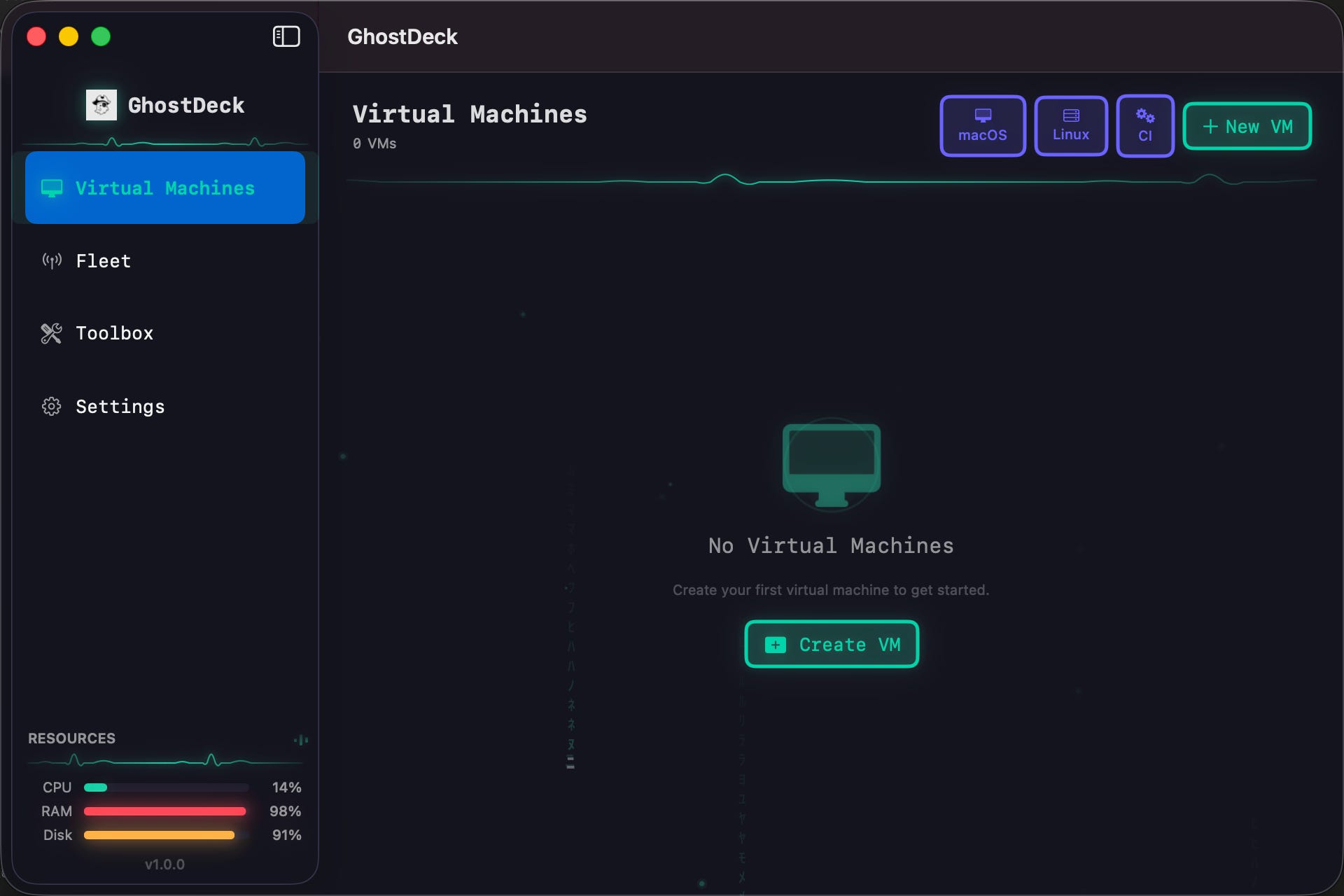
TL;DR — GhostDeck is our native macOS VM manager, and as of this week the whole thing is on GitHub under the MIT license. Free. No account, no license server, no sales guy named Chad “circling back.” Spin up disposable Apple Silicon VMs from the menu bar, wire them to AI agents through 89 MCP tools, snapshot in under 100ms, and burn it all down when you’re done.
Source: https://github.com/space-pirate-zero/Ghost-Deck
The pitch: https://ghostdeck.spaceshipalpha9.co
The confession first
Here’s the thing nobody in the VM business will say out loud at the bar: virtualization has been a tollbooth for twenty years. VMware wants $300 a year. Parallels wants $130. Docker Desktop wants $21 a month to run the thing your machine already knows how to do. Apple shipped Virtualization.framework sitting right there in the OS — free, native, fast as hell — and the industry’s response was to keep charging you rent to stand between you and it.
So we built the tool we wanted and we stopped pretending the source was a secret. GhostDeck is open now. Read every line. Fork it. Tell us it’s wrong and prove it in a pull request.
A virtual machine is just a computer you can lie to. It boots, it thinks it’s real, it does whatever you tell it, and then you delete it and it never existed. That’s the whole magic trick. GhostDeck’s job is to make that trick so cheap and so fast you stop thinking about it — a VM becomes a thought you have and then throw away.
What it actually does
One-click Linux. Ubuntu, Fedora, Debian, Arch — booted in about thirty seconds. No ISO scavenger hunt, no “download manager,” no seven wizard screens.
89 MCP tools. This is the part that matters in 2026. GhostDeck speaks the Model Context Protocol, so an AI agent — Claude, whatever you run — can create, configure, poke at, and destroy VMs on its own. The machine builds its own machines.
Sub-100ms snapshots. Freeze a VM’s exact state and restore it faster than you can blink. Branch it. Break it. Roll it back. A hundred times before lunch.
Bonjour mesh. VMs find each other on the local network automatically. Stand up a five-node cluster and simulate a whole production topology on one laptop.
Container runtime. OCI containers in lightweight VMs. No Docker Desktop tax.
It’s a menu-bar app. The most powerful thing about GhostDeck is that it disappears. It lives up in the corner and gets out of your way.
And it’s not vibes — it ships with 1,571 tests. We wrote those so you don’t have to trust us.
The part you came for: the two hats
Every powerful tool has a black-hat story and a white-hat story, and they’re usually the same story told from opposite ends of the room. GhostDeck is a disposable-computer machine. Whether that’s a weapon or a shield depends entirely on which side of the keyboard you’re sitting on. Let’s not be coy about it.
🖤 For the black hats (and the red teams who play them)
If your job is to break things — legally, on an engagement, with a signed scope — a VM manager is the difference between craft and chaos.
The burner lab. Malware analysis wants a machine you can infect, watch, and incinerate. GhostDeck spins that machine up in thirty seconds and snapshots it before detonation. You pop the sample, watch what it does, then restore to clean state in under a hundred milliseconds and do it again with the next one. No re-imaging. The snapshot is your undo button for reality.
The agentic detonation range. Point an AI agent at a fleet of throwaway VMs through those 89 MCP tools and let it run the tedious parts of an assessment — enumerate, fuzz, pivot, document — inside a sandbox that can’t touch anything real. The agent gets root on machines that don’t exist. When it’s done, they stop existing.
The clean identity. Every VM is a fresh machine with no history, no cookies, no fingerprint from the last op. Bonjour mesh lets you build a whole fake network to move through, so you can rehearse a lateral-movement chain against a topology you stood up in five minutes.
Cost = zero. The old joke is that the tools cost more than the bug bounties pay. Not anymore. A red-teamer with a MacBook and GhostDeck has a full detonation lab for the price of the laptop.
The honest caveat, because we don’t punch down: this is a productivity tool, not a hall pass. Everything you do in a VM is only as legal as the engagement behind it. GhostDeck makes the lab free. The authorization is still on you.
🤍 For the white hats (and everyone defending the walls)
Flip the same tool over and it’s a shield.
Detonate the phishing attachment safely. A weird .dmg, a suspicious payload, a “please review this invoice.” Open it in a GhostDeck VM that’s air-gapped from anything that matters. Watch it try to phone home. Learn exactly what it does. Restore. Malware triage without betting the farm.
Reproduce the bug on a clean box. Half of security work is “it happens on their machine, not mine.” GhostDeck gives every investigation a pristine, identical starting point. Snapshot clean, reproduce the CVE, capture the evidence, roll back.
Patch-test before you ship. Stand up a mesh that mirrors your topology, apply the patch across the fleet, watch what falls over — all local, all free, all destroyed by dinner.
Train the humans. Build a deliberately vulnerable network out of disposable VMs and let your juniors attack it. Break it, reset it, run the drill again tomorrow with a fresh copy. A cyber range that fits in a menu bar.
Audit the tool itself. This is the whole reason we open-sourced it. If you’re defending something serious, you should never run a black box you can’t read. Now you can read GhostDeck top to bottom, confirm it does exactly what it says and nothing it doesn’t, and then trust it. Open source isn’t a marketing checkbox for a security tool — it’s the entire point.
Why we gave it away
Because a virtualization tax is a stupid reason to have fewer people learning security. Because the best way to prove a security tool is honest is to publish the source and shut up. And because we’re a studio that builds in the open — snarky commit messages and all — and it felt like a lie to keep this one behind a curtain.
Diogenes lived in a barrel to prove he didn’t need the stuff everyone told him he needed. GhostDeck is a little of that: you don’t need the $300 license and the account and the cloud dashboard. You need a Mac and a machine you’re allowed to lie to. The rest is counterfeit.
Clone it. Star it. Break it. File the issue. If it’s good, tell a friend who’s still paying rent on a VM.
Repo: https://github.com/space-pirate-zero/Ghost-Deck — MIT licensed. Star it, fork it, ship it.
Signal finds signal.